From above, a stain on carpet can look small and contained. Underneath, the story is usually different. Carpet fibers wick liquid downward into the pad, which acts like a sponge and spreads it outward well beyond the visible mark. Whatever passes through the pad reaches the tack strip along the walls and the subfloor beneath.
That is why biohazard cleanup on soft flooring tends to involve cutting out sections rather than shampooing. Household carpet cleaners and rented extractors can lighten the surface while leaving contaminated material in the layers below, along with odor that returns once the room warms up.
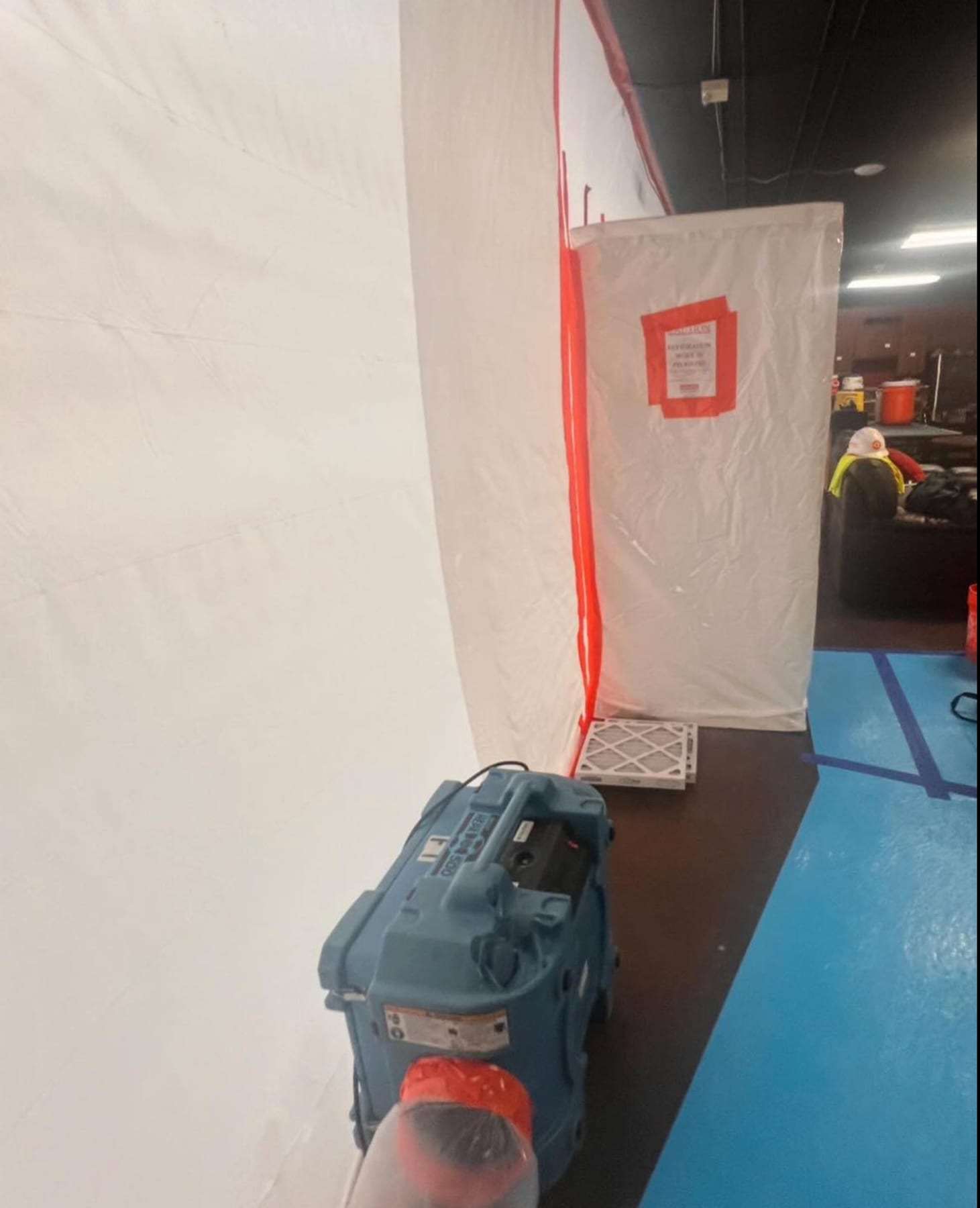
Plastic containment with an air scrubber. Used to illustrate this step; it is not a photo of a job connected to this site.
Layer by layer: what is usually found under a carpeted floor
- Layer
- Carpet face
- How it reacts to fluids
- Absorbs readily; stains may be cleaned but fibers and backing hold residue
- Usual outcome
- Affected section cut out and bagged for disposal
- Layer
- Pad
- How it reacts to fluids
- Highly absorbent foam or rebond; spreads fluid widely
- Usual outcome
- Removed well past the visible edge
- Layer
- Tack strip
- How it reacts to fluids
- Raw wood soaks up liquid at room edges
- Usual outcome
- Replaced where contaminated
- Layer
- Plywood or OSB subfloor
- How it reacts to fluids
- Porous; can absorb deeply, especially at seams
- Usual outcome
- Cleaned and sealed if shallow, cut out if saturated
- Layer
- Older plank subfloor
- How it reacts to fluids
- Gaps between boards let fluid run to joists below
- Usual outcome
- Boards and sometimes joist surfaces addressed
- Layer
- Concrete slab (basements)
- How it reacts to fluids
- Porous; can absorb and hold odor
- Usual outcome
- Cleaned, disinfected and often sealed
Typical of many metro Denver homes; your floor may differ.
How a careful removal usually proceeds
- Mark the true extent.The provider checks beyond the visible stain, lifting carpet at edges and checking pad and subfloor for spread.
- Contain the room.Doorways and vents are covered so particles and odor stay inside the work area.
- Cut and package.Contaminated carpet, pad and strip are cut into manageable pieces and packaged as regulated waste where required.
- Treat the subfloor.Exposed subfloor is cleaned and disinfected. Saturated sections are removed; lightly affected surfaces may be sealed with a primer suited to odor blocking.
- Leave it ready.The room is left clean and dry with a clear note of what was removed, so a flooring installer can take over.
Common questions
- Can matching carpet be installed in just one room?
- Sometimes. Seams between old and new carpet can show. That is a flooring and insurance question, separate from the biohazard work.
General information for the Denver area, not a quote or professional advice. In an emergency, call 911.