Much of Lakewood was built out in the decades after World War II: one-story brick and frame ranches, split-levels and bi-levels, many with full or partial basements and some with crawlspaces. Newer townhomes, apartments and mixed-use development sit along major corridors. To the west and south, neighborhoods meet foothills, parks and open space, which brings wildlife closer to homes.
That combination shows up in biohazard work in a particular way. Alongside injuries and unattended deaths, which happen everywhere, Lakewood homeowners deal with animals that get into crawlspaces, attics and wall cavities and sometimes die there, and with deer mouse infestations in garages, sheds and basements that sat unused. In a crawlspace, contamination sits on soil, vapor barrier and insulation, often in tight, hard-to-reach areas.
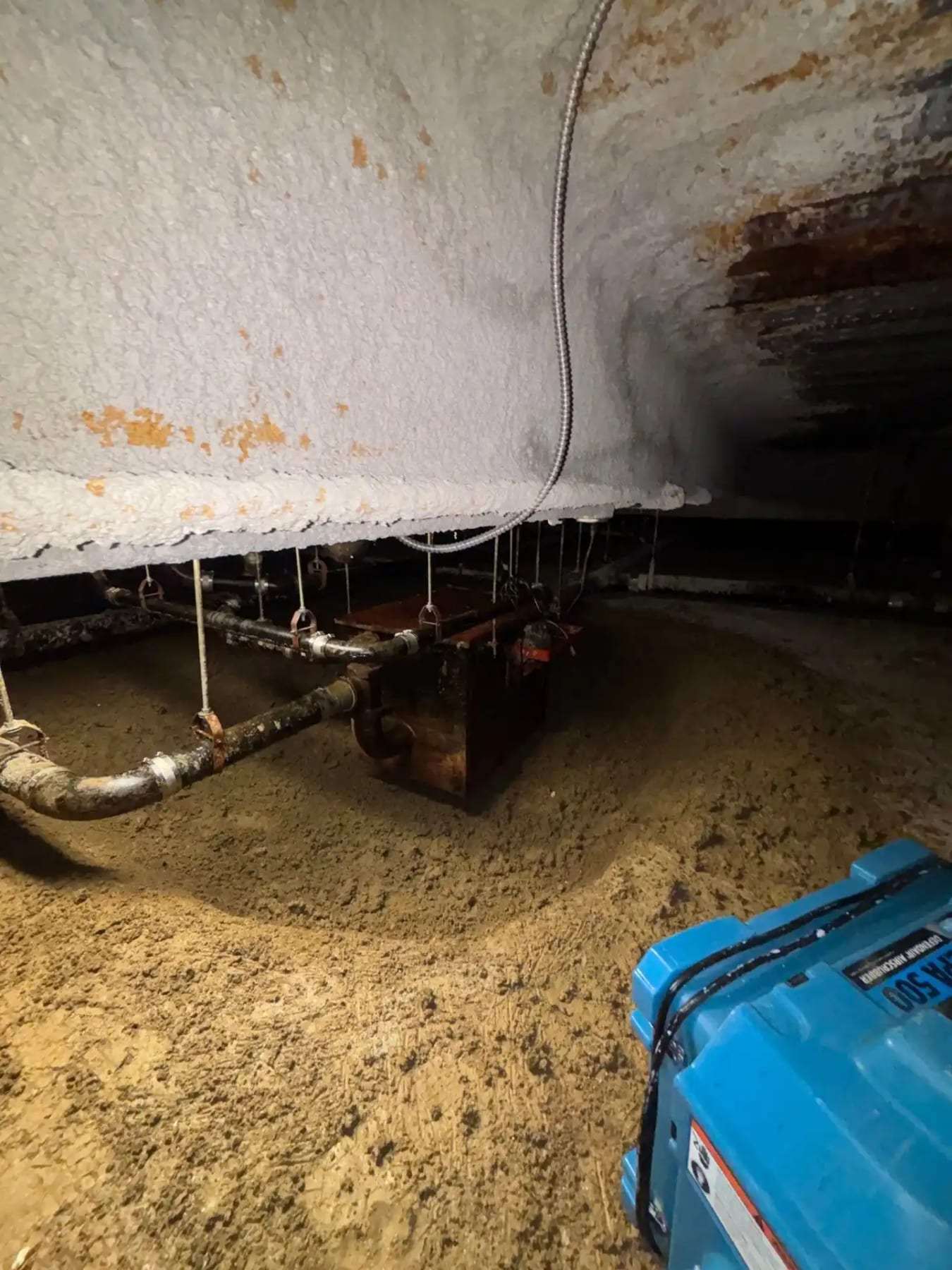
Dehumidifier in a dirt crawlspace below exposed pipes. One example of what this stage can look like; it is not a job connected to this site.
Where problems tend to appear in Lakewood homes
- Space
- Crawlspace
- Typical issue
- Rodent nesting, droppings and occasionally dead animals on the vapor barrier
- Usual approach
- Wet-clean and remove droppings, replace contaminated vapor barrier and insulation, seal entry points
- Space
- Attic
- Typical issue
- Animal entry through vents or roof gaps, droppings in insulation
- Usual approach
- Remove contaminated insulation, clean framing, repair entry points
- Space
- Unfinished basement
- Typical issue
- Rodent activity in stored items, older sewer line backups
- Usual approach
- Sort and discard contaminated stored items, clean and disinfect slab
- Space
- Finished basement
- Typical issue
- Carpet and drywall affected by fluids or sewage
- Usual approach
- Remove porous finishes to a clean margin
- Space
- Detached garage or shed
- Typical issue
- Deer mouse droppings after long closure
- Usual approach
- Air out, wet-clean, bag and seal; never sweep dry
If you suspect a dead animal under the floor or in a wall
- Locate by smell and flies.Odor tends to be strongest near the source. Note where it is worst at different times of day.
- Do not open walls blindly.Cutting drywall in the wrong place adds damage. A wildlife or cleanup professional can often pinpoint the location.
- Protect yourself if you go in.Crawlspaces need gloves, a respirator rated for particles and coveralls, and someone outside who knows you are there.
- Remove and disinfect.The animal and contaminated materials are bagged and removed, and the area cleaned and disinfected.
- Fix the entry point.Without sealing how the animal got in, the problem tends to repeat.
Contacts commonly involved in Lakewood
- Police
- Lakewood Police Department for welfare checks and emergencies within city limits
- Coroner
- Jefferson County Coroner's Office
- Wildlife questions
- Colorado Parks and Wildlife offers guidance on living with wildlife; licensed wildlife control operators handle removal
- Permits for repairs
- City of Lakewood building division; ask whether your repair scope needs a permit
General information for the Denver area, not a quote or professional advice. In an emergency, call 911.